
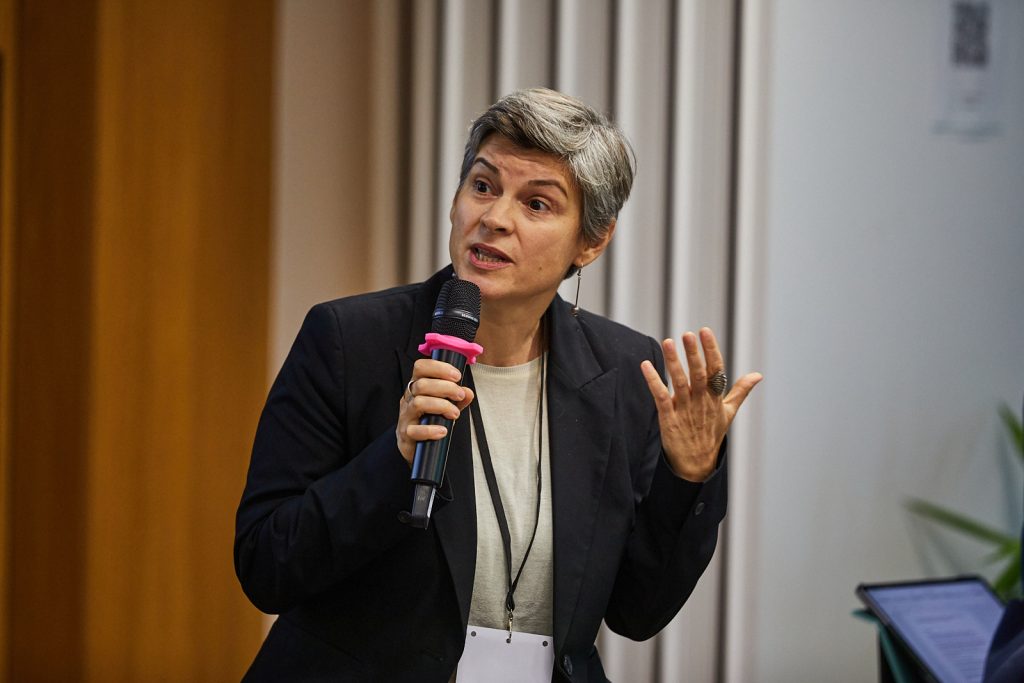
On 25 October 2026, a student-backed electoral list won Serbia’s snap parliamentary elections, despite two years of media blackouts, police violence and censorship. Before the elections, we spoke to curator and activist Milica Pekić about how a leaderless movement grew into one of the most influential political forces in Serbia — and ultimately achieved victory at the ballot box.
On 1 November 2024, the canopy of the newly renovated railway station in Novi Sad collapsed, killing 16 people. For Milica Pekić, a Belgrade art historian, curator and activist who has spent more than 20 years on Serbia’s independent art scene, it was the latest in a long series of tragedies. The same party has been in power since 2012, and she describes years of growing corruption and authoritarianism that peaked after the pandemic.
What followed was, in her words, the largest student movement in the country’s history, bigger even than 1968. Students occupied every public university in Serbia and lived inside their faculties for almost nine months. They demanded something simple: that institutions do their job and that those responsible for the collapse be held to account.
Those demands were never met. So the students changed strategy. They called for elections, drew up their own list of candidates and started campaigning. Serbia went to the polls on 25 October, with the students campaigning under the slogan “Serbia or mafia.”
A MOVEMENT WITH NO ONE TO TARGET
Authoritarian governments have a familiar playbook for dealing with opposition: find the leader, discredit them, cut them off. In Serbia, Pekić says, that playbook has stopped working, because there is no leader to find.
The students organise through plenums: open assemblies in each faculty where anyone studying there can speak, debate and vote. Plenums coordinate with other plenums, across universities and cities, up to the national level. There are working groups but no figureheads. And, simply put, there are so many of them: there aren’t just a few faces of the movement.
“That’s their greatest difficulty,” she says, referring to the regime. “They don’t know where to direct their attacks.”
The candidate list they assembled for the election illustrates how this works. Throughout the process of forming the list, pro-government media speculated about its potential candidates and attempted to identify the people who might occupy leading positions. But the students’ internal decision-making process did not follow the logic of individual leadership or political hierarchy. At the list’s first public presentation, the person who spoke was candidate number 200 on the ballot. “They do not operate according to these hierarchies of who comes first, second or last,” Pekić says. The approximately 250 candidates include professors, schoolteachers, a miners, farmers and factory workers, people the students had come to trust over two years of struggle. More than 130 candidates hold doctoral degrees.
NOBODY IS LEFT BEHIND
The government’s response has been harsh. Pekić describes police beatings, arrests and students charged with the gravest offences under criminal law, as if they were terrorists. National broadcasters either ignore the movement or campaign against it, portraying students as a threat to the country.
But each time one person is singled out, the whole movement shows up. When a student, or any citizen, is arrested or brought to court for protesting, hundreds gather outside the police station or courtroom.
“It makes a difference,” she says. “Nobody is left behind. Nobody is on their own.”
The same logic applied to the media blackout. Unable to reach people who get their news from national television, students walked and cycled hundreds of kilometres from town to town, stopping in villages to talk to people directly, face to face. People cooked for them in the streets. Farmers drove tractors to protests to protect them from the police.
What strikes her most is the tone of these young people, many in their twenties. They speak with remarkable clarity and calm. “There is no aggression, there is no rage,” she says. “There is calmness, peace, persistency, and I would say kindness.”
“Wherever they try to isolate or marginalise us, or to make us invisible,” she says, “we respond with even greater strength.”
CULTURE UNDER OCCUPATION
Pekić’s main focus is culture. Together with colleagues from both the independent scene and public institutions, she co-founded an informal initiative called the Community of Arts and Culture. One of its first actions was a “Chronicle of repression,” documenting cases of censorship, harassment, cancelled contracts and testimonies of people who lost their jobs for supporting the students.
“This level of repression and censorship in culture never happened before,” she says. “But at the same time, resistance of people from the arts and culture has never been stronger.”
Theatre actors have been taking their bows with their hands painted red, the movement’s symbol of blood on the government’s hands. The management of various theatres have sadly responded by programme cancellations and the suspension of performances. In certain institutions, such as the National Theatre in Belgrade, controversial rulebooks were adopted restricting employees’ freedom of public expression, and the theatre was closed for two months under the pretext of fire protection system works. The aim is to keep audiences from coming face to face with resistance.
The most striking response to government censorship came from BITEF, Belgrade’s international theatre festival, one of Europe’s most celebrated for decades. Last year, she says, the city government censored its programme and the curatorial team resigned. So they organised a counter-festival. Censored productions and foreign companies who had been invited came anyway, as an act of solidarity.
This year, marking the festival’s 60th anniversary, it went further: 60 curators each ran a micro-stage across Belgrade, in private flats, on street corners and in the few remaining uncensored spaces, each inviting artists from the festival’s history. There was no central selection and no hierarchy of experts deciding what counts. The festival’s slogan, which Pekić quotes in her article for Chartist, captures the spirit of the movement:
“BITEF is wherever we gather.”
BEYOND THE LONE GENIUS
This is more than tactics for Pekić. Her research has long focused on artistic practices that challenge the dominant system, and on moving away from the myth of the solitary genius towards collaborative, horizontal ways of working.
She thinks the same myth shapes our idea of democracy. Every four years we pick a representative who is supposed to make every decision in our name. Voting, she points out, takes about three seconds with a pen and paper, and the rest of the time we watch from the sidelines. She calls it “a mimicry of democracy.”
The plenums are the opposite, and she’s honest that they can be difficult.
“It is frustrating sometimes, it takes patience and time,” she says.
Debates in the early days lasted six or seven hours. People who disagree have to listen to each other in public until a vote decides. But she argues this creates something far more stable, and much harder to corrupt, than a party hierarchy where big deals get made behind closed doors.
She saw it first-hand when the students invited professionals to help develop their election programme. They set the core values themselves: free healthcare and education, workers’ rights, democratisation, decentralisation and an end to the privatisation of public and natural resources. They then reached out to people with expertise in different fields to translate these principles into concrete proposals. The process brought together a broad range of people from the cultural scene, including professionals from film, theatre, cultural heritage, visual arts, contemporary dance, music etc.
“People feel more ownership that way,” she says.
NOT JUST SERBIA
Despite its scale, the movement has received relatively little coverage in mainstream European media. Students cycled to Strasbourg and Brussels to present reports on the situation in Serbia, receiving support from diaspora communities along the way. Yet, Pekić argues, much of the international attention has travelled through less visible channels, what she describes as “capillary” networks of solidarity connecting citizens, artists, students and activists. Through these networks, many of her colleagues and fellow activists have been invited to speak at events and gatherings across Europe, sharing their experiences of the struggle directly with international colleagues.
And the interest goes both ways. Colleagues abroad tell her that censorship and self-censorship are rising in EU countries too. She points to Albania, where protesters are opposing a coastal development deal, and Croatia, where protests erupted over toxic waste reportedly buried in farmland. The details differ, but for her the pattern is the same: decisions about land, water and public resources are made without the people who live with the consequences.
“When these deals come to light,” she says, “people begin to organise and insist on having a say in decisions that affect them.”
Even before the 25 October elections, Pekić described Serbia as a real-time example of what can happen when people decide to organise and act collectively. “I have no clue where it will lead,” she admitted at the time. Just weeks later, the student-backed movement won the parliamentary elections, showing that even in the face of media blackouts, police violence and censorship, horizontal organising can become a powerful political force.
Milica Pekić is an art historian and curator based in Belgrade, Serbia. She is a co-founder of KIOSK Platform for Contemporary Art and was involved in establishing the Independent Cultural Scene of Serbia Association and KOOPERATIVA – Regional Platform for Culture. Her work focuses on collaborative artistic practices, collective authorship and institutional transformation.
